The National Association for Year-Round Education (NAYRE) advocates for improved PK–12 education through alternative school calendars.
About Us
NAYRE promotes the Balanced School Calendar Initiative, helping schools explore alternative calendars designed to reduce summer learning loss, educator burnout, and absenteeism while supporting unfinished learning and providing more consistent access to students.
What is a Balanced School Calendar?
A balanced calendar spreads 180 school days across the year, with breaks that can include intersession learning opportunities that focus on real-time remediation and enrichment.
01
Better School Year
A Balanced School Calendar reshapes the traditional 180-day school year to better align with today’s lifestyles. Rather than one long summer break, students and staff enjoy periodic, shorter breaks, supporting continuous learning while fitting more naturally into family routines and modern schedules.
02
Customizable
The most widely researched model is the 45/15 structure, also known as nine weeks of instruction followed by three weeks off. However, every district has unique needs, so we encourage you to connect with one of our Balanced Calendar experts to explore customized calendar development tailored to your community.
03
Intersession
Intersessions are short breaks between school terms that give students extra learning opportunities, like enrichment, remediation, or hands-on projects, while letting teachers experiment with curriculum and reduce review time. Especially helpful in preventing learning loss, intersessions benefit all students, not just those at risk.
Books to Study
Summer versus School II
In Summer versus School II: The Balanced Calendar of School, Work, and Life, the authors explore the successes and challenges of moving from the traditional 10-month calendar to implement ones that are more in line with the needs of modern families.
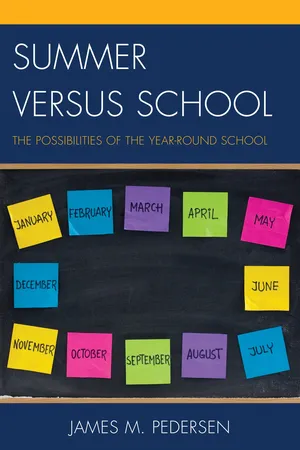
Summer versus School
As American educational reformers continue to find innovative ways to address the global achievement gap, many experts seem to agree that modifying the traditional academic calendar will enhance student learning and reduce summer learning loss.
Does the Balanced School Calendar work?
Schools with a balanced calendar often show higher achievement (Pedersen, Hornak, & Mishra, 2025). With shorter summer breaks of five to seven weeks compared to the traditional ten to twelve weeks, students benefit from consistent teacher partnerships, less learning loss, and more opportunities for enriched curriculum and expanded learning experiences.
Does a Balanced School Calendar require more days of school?
Balanced calendars keep the same number of school days as traditional calendars while adding flexibility. With input from families, education leaders shape schedules to fit their community. Teachers report that shorter instructional segments between breaks make planning easier, and ending a term before winter break boosts energy and readiness for students and staff (Pedersen, Hornak, & Mishra, 2025).
Why balance the calendar?
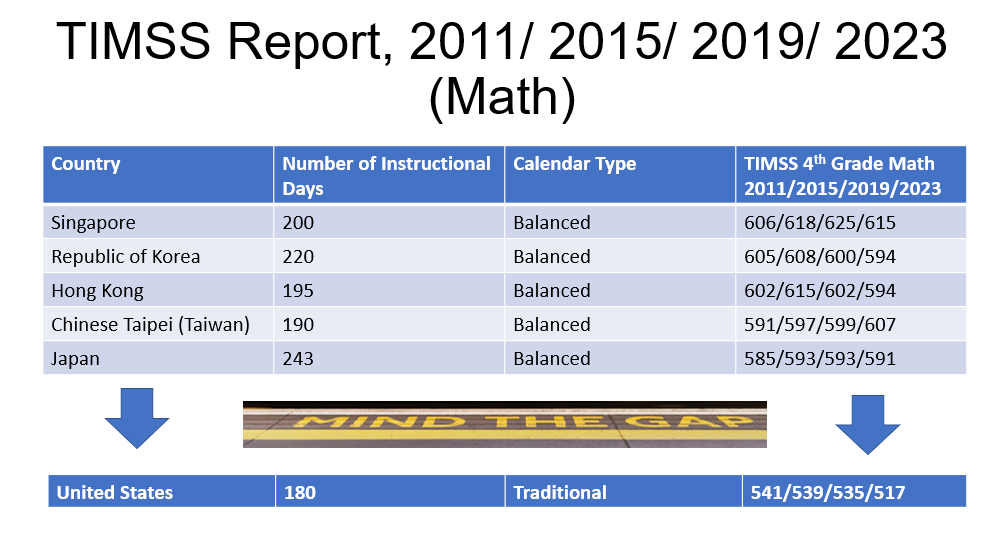
The traditional school calendar most widely used in the United States is ineffective. The United States is unique among industrialized nations in scheduling a long summer break of ten to twelve weeks each year. This tradition has shaped how students, families, teachers, and staff organize their lives for more than a century. It is time for a change!
Why is now the best time?
Perhaps one of the most powerful lessons learned from the COVID-19 Pandemic was how we spend our time should be reimagined. Educators have demonstrated that school can be done differently…this is the best time to imagine the possibilities!
Testimonials
“I have yet to meet an educator who experienced a balanced school calendar and wanted to return to the traditional model as once you live it, you love it.”
– David G. Hornak, Ed.D., Executive Director of NAYRE & Superintendent of Holt Public Schools, Holt, MI
“I attended a balanced calendar elementary school and tested a year ahead academically. After moving to a traditional calendar middle school, my scores dropped to a year behind. The balanced calendar made the difference for me.”
– Olivia, Student
“As a parent, the balanced school calendar just makes sense. Instead of one long summer where kids forget so much of what they learned, the shorter breaks throughout the year keep learning fresh and give families regular time to rest, travel, and reconnect. It fits the rhythm of modern family life much better. My kids thrived on the balanced calendar!”
– Craig, Parent
“A balanced school calendar is an excellent way for schools to promote continuous learning and helping maintain a balanced approach to learning. Shortening long summer breaks and adding regular intersessions provides opportunities for students to better retain knowledge and experience less summer learning loss. Students are not the only ones who benefit from a balanced calendar; teachers find that additional breaks allow for more planning time and less burnout. A balanced calendar can cultivate healthier, fairer, and more academically successful school communities.” -James M. Pedersen, Ed.D., Assistant Director, NAYRE & Superintendent, Essex County Schools of Technology